
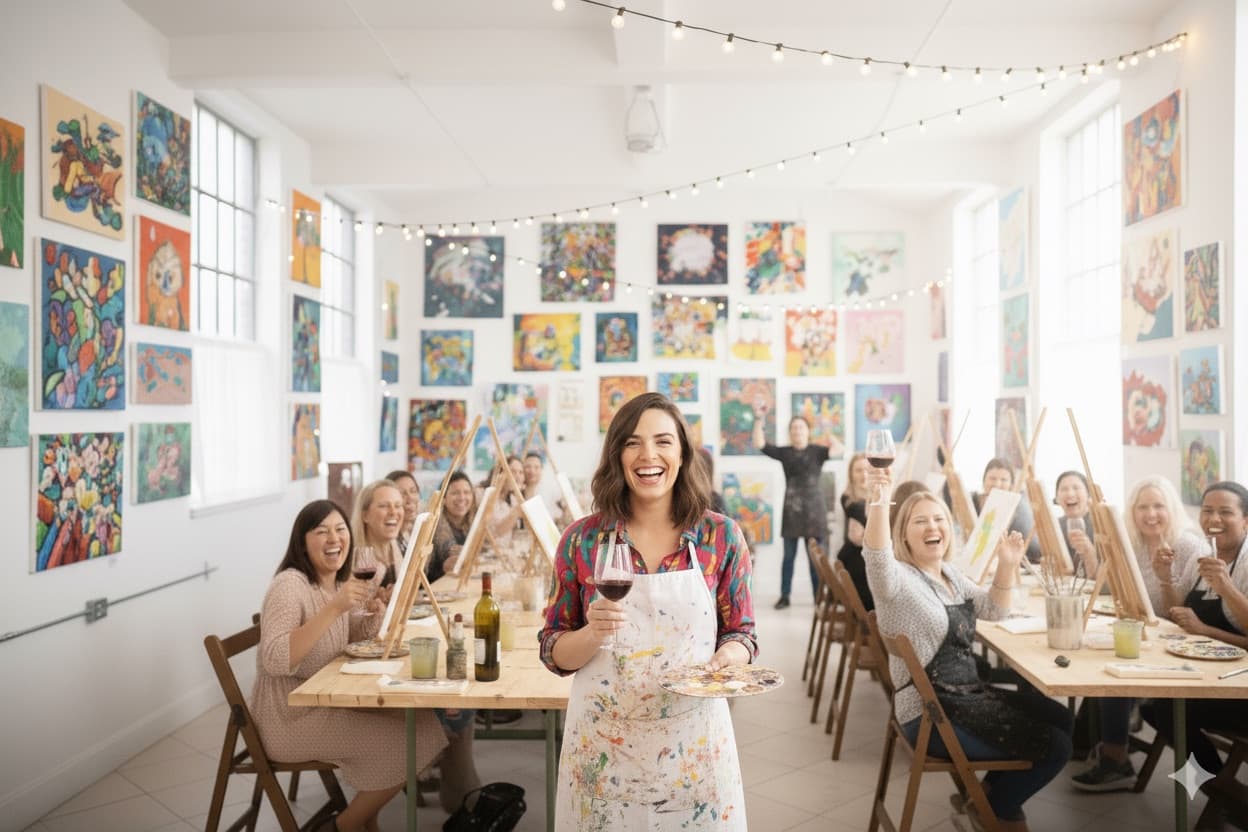
Which model should you start with?
Your model changes everything else — the property you need, alcohol rules, insurance, staffing, cost. These are practical starting points, not legal categories, so your local authorities and insurer are the ones who ultimately decide what applies to you.
- BYOB studio — guests bring their own drinks. Don't assume this gets you out of alcohol, venue, age, or insurance requirements. Describe your exact guest experience to your local authorities and ask directly.
- Licensed studio — you sell or serve drinks yourself. Confirm licensing, staff training, insurance, and age-check requirements before you commit to a property.
- Mobile or pop-up — you run events in bars, restaurants, or offices. Great for testing demand before signing a lease, but get it in writing who's responsible for alcohol, insurance, and guest safety — you or the venue.
- U.S. Small Business Administration: Apply for licenses and permitsWhy required licenses and fees depend on the activity, location, and issuing authority.
What belongs in your business plan?
A useful plan explains how you'll get guests in the door, how you'll actually run each class, and how you'll cover your costs. A simple one-pager is plenty for early testing — replace your assumptions with real quotes and test bookings as you get them.
- Who's your guest, and why are they booking — and who else nearby already serves that need?
- Your offer — public classes, private events, mobile events, drinks policy, what's included, your promise to the customer.
- Operations — venue, capacity, instructors, suppliers, prep, cleanup, accessibility, who owns what.
- Proof of demand — interviews, waitlist signups, a paid pilot event, competitor calendars.
- The financial model — startup costs, monthly fixed costs, per-class costs, ticket price, break-even seats, and a realistic worst-case scenario.
- Launch plan — your first calendar, booking flow, local partnerships, and marketing channels.
- Risks and approvals — licenses, alcohol rules, insurance, property condition, refund exposure.
- U.S. Small Business Administration: Plan your businessThe business-plan, market-research, startup-cost, and break-even framework used in this guide.
How do you test demand before you sign a lease?
Run a small paid event at a partner venue, or take deposits for a clearly described upcoming class with honest refund terms. Track paid bookings, where people found you, the questions they asked, cancellations, and what the setup and cleanup actually took.
One good night doesn't prove a studio will work long-term. Repeat it across a few dates, compare it to what's already out there locally, and decide ahead of time what result would actually justify signing a lease.
- U.S. Small Business Administration: Plan your businessThe business-plan, market-research, startup-cost, and break-even framework used in this guide.
What legal and insurance boxes do you need to check?
Get proper local advice on your legal structure. Get general liability insurance that specifically covers art activities (and alcohol service, if that applies to you). Ask your city directly what business licenses and occupancy rules apply to a class-based venue. If you're serving alcohol, look into the license timeline before you sign anything — the cost, wait time, and whether it transfers vary a lot by location.
- U.S. Small Business Administration: Launch your businessThe launch sequence covering location, business structure, registration, tax IDs, permits, banking, and insurance.
- U.S. Small Business Administration: Apply for licenses and permitsWhy required licenses and fees depend on the activity, location, and issuing authority.
- U.S. Department of Justice: ADA Standards for Accessible DesignThe need to check physical accessibility when selecting or altering a U.S. studio space.
How should you pick a location?
Paint and sip is a night-out product — people choose you the way they choose a restaurant. Is it near dinner spots? Is there parking? Does getting there feel easy? Compare rent against real access, visibility, and demand, rather than assuming the cheapest space is actually the cheapest option overall.
Calculate your real capacity from your actual tables, walking space, accessibility, occupancy rules, storage, and a wash-up area — not some generic square-footage guess. A space without a decent sink or cleanable surfaces can rule itself out fast, no matter how good the price looks.
- U.S. Small Business Administration: Launch your businessThe launch sequence covering location, business structure, registration, tax IDs, permits, banking, and insurance.
- U.S. Department of Justice: ADA Standards for Accessible DesignThe need to check physical accessibility when selecting or altering a U.S. studio space.
What supplies do you need before opening night?
Your core kit: easels or table stands, canvases, acrylic paint, brushes, aprons, and something to protect your tables and floors. Buy enough for the class size you can actually run well, plus a small buffer based on how fast your supplier can restock. Reorder based on what you actually use, not some industry ratio you read somewhere.
- U.S. Small Business Administration: Plan your businessThe business-plan, market-research, startup-cost, and break-even framework used in this guide.
How should you price your first classes?
Add up what one occupied seat actually costs you — supplies, instructor time per seat, and a slice of rent for that session — then price with real margin above that, and check it against comparable local experiences. Pricing too low can leave you with full classes that still don't cover your costs. (We wrote a whole separate guide on this — see below.)
- U.S. Small Business Administration: Plan your businessThe business-plan, market-research, startup-cost, and break-even framework used in this guide.
What does the booking experience need to include?
A guest should be able to see the painting, the date, the location, how long it runs, the price, what's included, drinks policy, age rules, accessibility info, availability, and cancellation terms — all before paying, on their phone. Making people call, email, or create an unnecessary account just adds friction and more questions for your team to answer.
This is exactly the problem Painta was built to solve for paint and sip studios specifically — scheduling, payments, instructors, private events, and check-in all in one system, with no guest account required. Whatever software you end up choosing, test the whole phone journey yourself and cut out anything unnecessary before opening night.
- Painta: Painta product overviewThe current Painta booking, scheduling, instructor, private-event, payment, and check-in capabilities described here.
How should you plan your first month?
One big, packed opening night followed by an empty calendar doesn't build a real business. Publish enough classes to give people another date to book. Invite friends, local businesses, and community groups to your early sessions. Put your booking link everywhere your name shows up — Google Business Profile, Instagram bio, every reply to every DM.
Start taking private-event inquiries from day one if you can actually deliver them well. Price your room commitment, planning time, staffing, supplies, and cancellation risk separately from a regular class ticket, and be upfront about what's included before you take a deposit.
- U.S. Small Business Administration: Plan your businessThe business-plan, market-research, startup-cost, and break-even framework used in this guide.
- Painta: Painta product overviewThe current Painta booking, scheduling, instructor, private-event, payment, and check-in capabilities described here.
Source of truth
Sources and verification
We prioritize primary sources. Practical judgment is presented as Painta operator guidance, not a universal rule.
- 01Plan your business
U.S. Small Business Administration
The business-plan, market-research, startup-cost, and break-even framework used in this guide.
Checked: 2026-08-29 - 02Launch your business
U.S. Small Business Administration
The launch sequence covering location, business structure, registration, tax IDs, permits, banking, and insurance.
Checked: 2026-08-29 - 03Apply for licenses and permits
U.S. Small Business Administration
Why required licenses and fees depend on the activity, location, and issuing authority.
Checked: 2026-08-29 - 04ADA Standards for Accessible Design
U.S. Department of Justice
The need to check physical accessibility when selecting or altering a U.S. studio space.
Checked: 2026-08-29 - 05Painta product overview
Painta
The current Painta booking, scheduling, instructor, private-event, payment, and check-in capabilities described here.
Checked: 2026-08-29
Legal, tax, and licensing requirements vary by place and operating model. Confirm the final decision with the relevant local authority or qualified adviser.
FAQ
Questions operators ask next
How long does it take to open a paint and sip studio?
There's no universal timeline. A mobile setup can skip the storefront buildout entirely, while a leased or alcohol-serving studio depends on property work and local approvals. Ask each authority and supplier directly for current timelines before you set your launch date.
Do I need to be an artist to run one?
No. You can hire or contract instructors while you focus on the guest experience and running the business. Your plan should still cover who develops the paintings, teaches each class, covers absences, checks supplies, and keeps the experience beginner-friendly and consistent.
Do I need a liquor license?
Depends entirely on local law and your exact alcohol model. Selling drinks, including one in the ticket, allowing BYOB, or opening/pouring guest drinks can all be treated differently. Confirm your exact plan with your local regulator directly.
Is a paint and sip studio profitable?
It can be — but that depends on paid seats, ticket price, direct costs, rent, labor, cancellations, and your mix of public classes vs. private events. Build your answer from your own break-even seat count and real results, not some generic industry number.
What software does a paint and sip studio need?
At minimum: online booking with upfront card payment, a class calendar, and a way to manage instructors and check-in. Painta brings all of that together specifically for paint and sip studios, with no account required for guests.
What should a paint and sip business plan include?
Include the customer and occasion, class and private-event offers, venue model, capacity, instructors, permits, suppliers, startup and monthly costs, per-class economics, booking flow, marketing channels, launch calendar, and the evidence that would justify your next commitment.